Saturday, August 23, 2014

History for Young Readers

Numbering All the BonesNumbering All the Bones by Ann Rinaldi
My rating: 4 of 5 stars

I had the pleasure of unpacking 30 cartons of books for our English department yesterday, and borrowed this one for the weekend. I ended up reading it before breakfast this morning. A perfect way to start a lazy Saturday.

I'm giving this 4 stars because I think it has so much historical information in it for discussion.

Eulinda is her master's daughter, but lives in that strange window of being a little bit accepted by her father, but really belonging to the slave population. It is in the throes of the civil war, and everyone knows the South will lose, but the slaves have not been declared free as yet.

Near the plantation is the infamous Andersonville prison. There are many true facts about the prison woven into the story. 13,000 dead in Andersonville, did you know that? It was, in essence, as the author points out, a death camp where food, medicine and kindness were missing.

New learning for me was the fact that Mr. William Griffin, who was an ex-confederate, came to Andersonville Prison of his own accord, and, used his own money, to clean up and put to order the graves of those who died there (it was not protected and animals were disturbing the graves). Eventually Clara Barton and Mr. Griffin worked together to honor the dead. Dorence Atwater, whose job at  Andersonville was to record the dead, assisted them in identifying graves. Headstones were erected to mark the graves. Can you imagine recording thousands of dead people. One wonders how that would affect a life.

Eulinda's story, and that of her slave brothers, are the backdrop for the historical context.

As I think of the news in the world today, people being beheaded on the internet for all to see, the continued warring in the Middle East - I can't help but wonder with the Psalmist, "Lord, how long". God created us to live in peace, to live with compassion,kindness, humility, gentleness and patience (Colossians 3), we are doing a pretty miserable job of it!

It's good to remember that God raises up people like Clara Burton and William Griffin to help us get back on track.


View all my reviews

Bread and Life

Stones for BreadStones for Bread by Christa Parrish
My rating: 4 of 5 stars

What I will remember most about this book is how the descriptions of bread making was woven into the story as a whole. In fact, I think I am intrigued enough with the sourdough recipes to try making my own sourdough starter. There is a particular recipe for a chocolate sourdough bread, with actual pieces of dark chocolate baked into it, that is especially appealing.

Liesl owns her own bakery.It seems as though bread and the making of it are an essential part of her nature. Her feelings of family, and grief (after losing her mother tragically at an early age), are all tied into her bread making. She shares her bread with customers and churches more easily than she shares herself. Liesel loves the making of bread and it is a sort of therapy, as well as escape for her life.

Liesl's bakery "Wild Rise" (a reference to sourdough starter) becomes a family place for a variety of societal misfits that come to work for her. She reluctantly loves each of them, and particularly a little girl named Cecilia.

Liesl's grandmother explains to her about sourdough, and how you must feed it with flour and water until it can be made into bread "again and again,every day so the children have brot. Always something is in this pot, waiting to eat". When Liesl says that she didn't know "bread was so hungry all the time", Oma says "We are all hungry all the time. Every living thing." And isn't that the truth. Adding to the family theme, some of Liesel's sourdough starter has been fed through the generations, coming over from the old country with her grandmother.

There is a lot of history about bread and it's role in the lives of the rich and poor woven throughout the book.

Which brings us to another underlying theme of the story, which is that Jesus is the bread of life. If you are a not a Christian, don't let this scare you off, because this theme is just part of who the characters are,and I feel it is really understated. In other words, I don't feel preached at, it's just a part of the character's stories that comes up now and again.

I do like a thought Liesl has on community:
"all of us with pieces missing, all of us starfish, but instead of regenerating our amputated parts we've replaced them with one another".
I borrowed this book from the library on my kindle, but may be tempted to purchase the book itself for the recipes.


View all my reviews

Sunday, August 17, 2014

Twenty Years Too Busy?

Learning to Walk in the DarkLearning to Walk in the Dark by Barbara Brown Taylor
My rating: 4 of 5 stars

"Step 1 of learning to walk in the dark is to give up running the show."
Hmmm, that one is a hard one for me!

Although this quote only touches the tip of the iceberg in Barbara Brown Taylor's newest book, it captures, for me, my great fear of not being in control of my circumstances. God keeps reaching out to teach me, to humble me, into trusting that He is with me in every life situation that I encounter.

Taylor talks throughout the book of society's interpretation of light (good) and evil (dark). There is an assumption, or at least a willingness to equate, darkness with evil, or absence of God.

Fear of the physical dark is not something I have struggled with. Interestingly enough, my favorite time of day is my morning prayer time, when I turn out the lights, and focus (or attempt to focus) my attention on God. For me, physical darkness is essential during this time. Relationship. This is what Taylor is moving us towards. Darkness is not bad, whether it is physical dark, or the darkness of grief, or fear, or loneliness. Dark times, yes, but God is still with us.

My favorite chapter is Chapter 5, "The Eyes of the Blind". In it, Taylor tells about her experience with Dialogue in the Dark, which is a way for sighted people to learn what it is like to be blind. Participants are plunged into darkness, given a cane, and then taken through several activities so they can know what a blind person experiences every day. She writes about how she doesn't know if her fellow participants are old, young, people of color, tall or short. She goes on to say:
"Maybe someone should start an Opaque Church, where we could learn to give up one kind of vision in hope of another. Instead of wearing name tags, we would touch each other's faces. Instead of looking around to see who's there,we could learn to listen for each other's voices."
This book also reflects my current journey. I feel, or have felt, pulled into a frenetic style of living. This book reminds me, slow down, experience your emotions, look, listen, be aware of the world and the people in it.

Towards the end of the book, the author and her husband are outside, in the dark, watching the moon rise. Her husband asks, "How long has it been since we've done this",and she answers, "Twenty years". "Why?" he asks.
"He and I both know why, but the answer makes me so sad that I cannot say it out loud. We have been busy. For twenty years."
If you are a reflective reader, then this book will give you plenty to ponder.


View all my reviews

Saturday, August 9, 2014

Faith, Hope and Love Put To The Test

Mennonite Meets Mr. Right: A Memoir of Faith, Hope, and LoveMennonite Meets Mr. Right: A Memoir of Faith, Hope, and Love by Rhoda Janzen
My rating: 4 of 5 stars

There is much to like about this book. Like Mennonite in a Little Black Dress, there is humor, and love of family. What I liked best about Rhoda's continuing story though, is how God was growing her. It tickles me that a woman who left the Mennonite community is now a Pentecostal attending church woman.I think it amuses Janzen a little bit too.

I liked the introspection that Janzen shared:
God respects our right to choose. Do we want to connect with Him, or do we want to live a life without him? We get to pick.
The difficulty of a marriage is that we fall in love with a personality, but must live with a character.(Peter DeVries, American Novelist).
Janzen,and other memoirists, are so honest. I don't know that I could write with such abandon and just lay myself out there like that.

It also tickles my funny bone that this modern woman, who is embracing God's Word, and working on obedience to Him is now displaying a definite conservative bent, at least from society's standpoint. What I see from this book is a woman who is moving into becoming the woman God created her to be. You will enjoy her story and learn from her!


View all my reviews

The Light Between Oceans

The Light Between OceansThe Light Between Oceans by M.L. Stedman
My rating: 5 of 5 stars

This is the best book I've read in a long while. It took me out of myself and into the story. The characters were my fellow journey men and women and their choices impacted my emotions.

Tom and Isabel (Izzy) are very different people. Tom is thoughtful and introspective; Isabel is  young, a little naive and playful. Like many of us married couples, they don't always understand each other, at times disappointing each other (and me!).

Izzy and Tom are bound together not just by love, but  by time and space. While living on this remote island, Isabel has two miscarriages and a stillborn birth with only Tom to attend to her. Tom tries to comfort her, but they grieve so differently and at times communication breaks down.

Out of the blue, a baby washes up on the island, and they claim her as their own. But, when their sweet Lucy turns 2, things start to unravel.

I was at times so disappointed in Tom and Izzy. They are just like you and me, people with choices. Our choices always impact people, we don't always know in what ways. They don't just affect other people, but also ourselves.  As I read I'd be saying to myself, oh no, they won't do that, will they? Their story captured my full attention. I was eager, yet sort of dreading, to see what would happen.

The author did a good job describing both the beauty and the loneliness of the Island, as well as the beauty and the function of the lighthouse. Additionally there were some nice analogies between the lighthouse and life.

I came late to this book, as it was a bestseller some while back,but I highly recommend it!


View all my reviews

Sunday, July 20, 2014

Am I Sanctimonious?

The Complete StoriesThe Complete Stories by Flannery O'Connor
My rating: 4 of 5 stars

I am still thinking about these stories and I finished them a week ago.

These stories!

First,I am not generally a short story fan. But, I kept running into mentions of Flannery O'Connor in different articles, and her literary greatness,so I decided to give her a try. It helped that I only paid $1.99 through a Kindle book deal.

These are not warm, funny heartwarming stories. In fact, many of them are a bit macabre, and honestly, I don't know exactly why, but I was compelled to read them all. Of course, now I am just busting to talk about them and I can't find anyone who has read them.Bah!

These stories beg to be talked about. Why? Because you will come up against your own sanctimonious attitudes. Because they make you think! Because the stories make you realize it is just a reality that there are bad people and bad things in this world.

Perhaps you already know this. Perhaps you don't want to think the best of everyone you meet like I do. My family is forever telling me I am naive,and guess what -I think I prefer to stay that way.

The first bothersome thing for me in the book is the use of the word "nigger". It's as bad as that "f" word that authors want to overuse these days. Actually, worse. The author was from the South, so I'm sure she captured the dialect of the times, but it was hard to get used to. Then there's the fact that many of the main characters saw themselves as so superior to black people, to "white trash", or to their parents. The main character in most of the stories could find nothing amiss in themselves, but only in those around them. It was not possible that they were in the wrong. Stories included people who were mean spirited or just plain bad. The people in the stories did not have much patience with anyone who was not them.

O'Connor's stories made me think: How often am I, without even thinking about it, making a judgment about another person-thinking myself superior to them. I don't believe you would often catch me being unkind to someone, but what is going on in my mind, am I being unkind in there? Am I choosing to be part of that person's story, or am I distancing myself from them. Am I being religious instead of clothing myself with "compassion,kindness,humility, gentleness and patience"?(Col. 3:12). In other words, is my Christianity real?

Then there's the whole bad people thing. In one of the stories(The Lame Shall Enter First), a father befriends a boy (sadly to the detriment of his relationship with his own son), and nothing he does makes a difference in that boy's life. The boy remains bad. This story really has my wheels turning. What does that mean for me personally and as a Christian? What does that mean for the world? (I told you I was naive!)

For me, O'Connor's stories are making me take a look at myself and my attitudes about people. About what I believe and how I put that in play. They are bothering me. I don't think that is a bad thing, but be prepared if you choose to try them for yourself.

View all my reviews

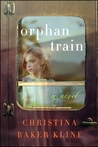
Orphan Train

Orphan TrainOrphan Train by Christina Baker Kline
My rating: 4 of 5 stars

Isn't it funny how well meaning people can disrupt the lives of the people they are trying to help?

The Orphan Train, although a novel, is based on a bit of American History, that helped some children, but perhaps other children not so much.

I liked how the author wove the story of Molly within the story of Vivian. We meet the child of today (Molly) and a child of yesterday (Vivian). We meet heartbreak and endurance. We meet love and hope. Their stories will touch your heart.

One of my favorite things is when history is woven into a novel and I learn something new. I not only make new friends through story, but it's framed in fact. Invariably this touches my heart and mind.

Can you imagine being an orphan and getting on a train and going from town to town to be "adopted"? Imagine the rejection when you are not chosen. Imagine the fear. Imagine being torn from all you know, perhaps even losing your name. It boggles the mind, and that is what the author helps us to understand.

There are some true orphan train rider stories at the end of the book,and those added to the depth of the story for me.

I would recommend this book to both the adult and young adult reader.

View all my reviews